Using low volatility ETFs to protect against market downturns

When markets experience heightened volatility, there are strategies which may help to protect your portfolio. Low volatility ETFs are great examples of such strategies, not only reducing overall volatility in the portfolio, but also offering additional diversification benefits.
Diversification is a proven portfolio management technique, and while neither diversification nor asset allocation ensures profits or guarantees against losses, both can be effective in managing long-term fluctuations in the market.
Low volatility ETFs aim to provide market-like returns with lower-than-market volatility, by investing in stocks that are less volatile, as the name suggests. Historically, some low volatility stocks have generated better risk-adjusted returns over time than the market. The chart below shows how Fidelity Canada U.S. Low Volatility Index works across market cycles and over time, compared with the broad U.S. equity market, as represented by the S&P 500 Index. A portfolio built with less volatility, over long periods of time, has actually delivered similar returns to the market while performing better in recessionary environments..
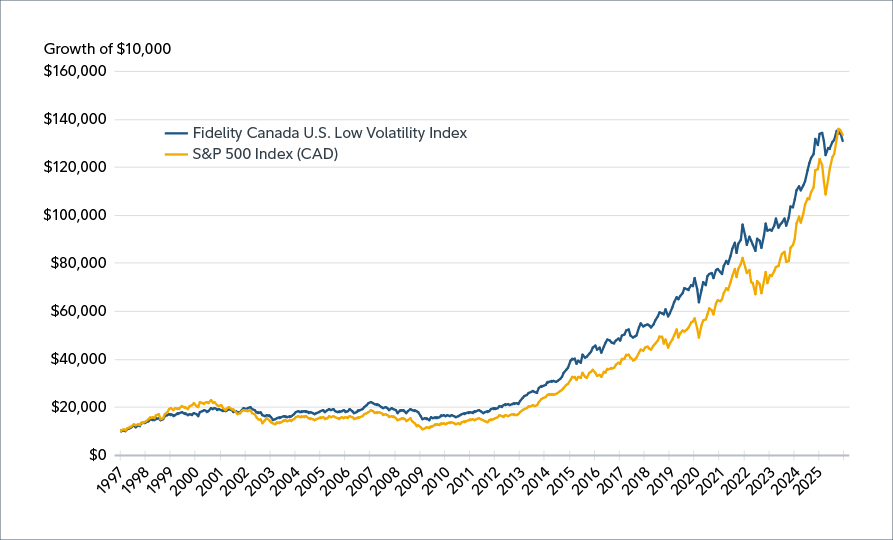
Source: Morningstar. Data as at December 2025.
While low volatility ETFs do not eliminate investment risk altogether, or prevent a loss in the event of a downturn, they are defensively positioned to protect against drawdowns. On the other hand, low volatility funds may underperform when the broad market is doing well and undergoing strong growth cycles.
As illustrated in the chart below, in instances of strong up markets such as 1998 and 2024, the Fidelity Canada U.S. Low Volatility Index underperformed. However, in market downtowns, such as 2008 and 2022, the Fidelity Canada U.S. Low Volatility Index outperformed the broad U.S. market by a wide margin.
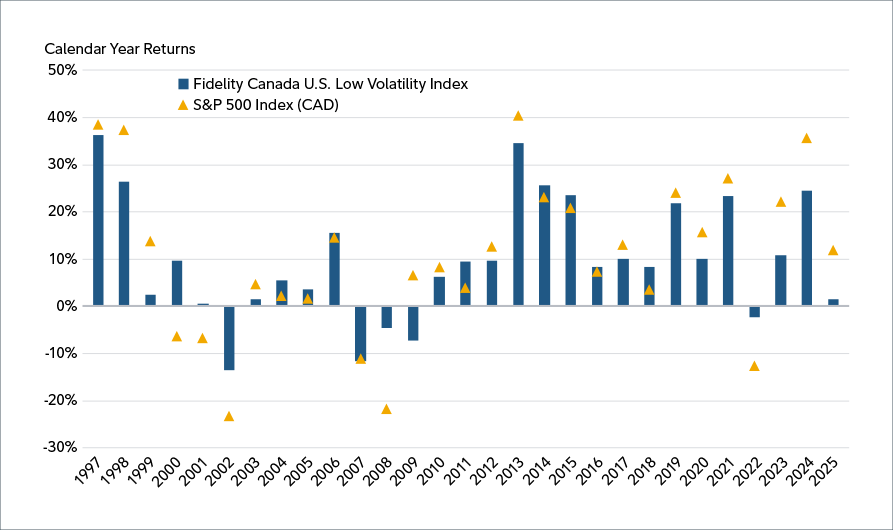
Source: Morningstar. Data as at December 2025.
Better downside protection
With low volatility ETFs, you lose less in drawdowns, which can lead to strong long-term performance. It's simple math: if you lose 50% of your $100, you will need a 100% return to make up your original portfolio value. Because of this asymmetrical relationship, having less downside allows you to recoup losses more quickly. The chart below shows the rolling peak-to-trough max drawdown of the Fidelity U.S. Low Volatility Index compared to the S&P 500 Index. In periods of market stress, the value of a Low Volatility portfolio draws down much less, which means it can recover quicker. By doing this over time, it could lead to better long-term performance. Sometimes the best offence is a good defence.
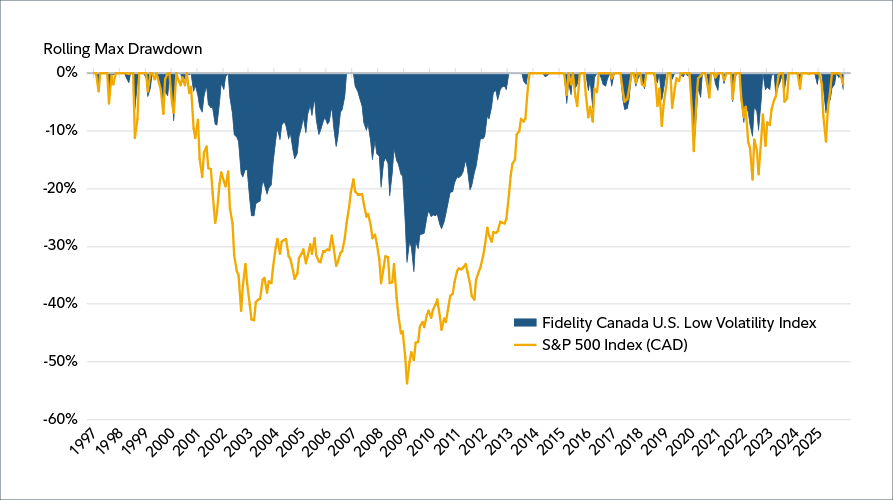
Source: Morningstar. Data as at December 2025.
Whether you prefer to take a passive approach to managing your investments or want to actively implement strategies to reduce your exposure to market volatility, there are a number of ways to position your portfolio using low volatility ETFs. Recent market events suggest now may be a good time to evaluate your investments to determine if your positions align with your investment goals.
Fidelity low volatility ETFs:

